
Why 7075 Aluminum Turns Black or Blotchy After Anodizing
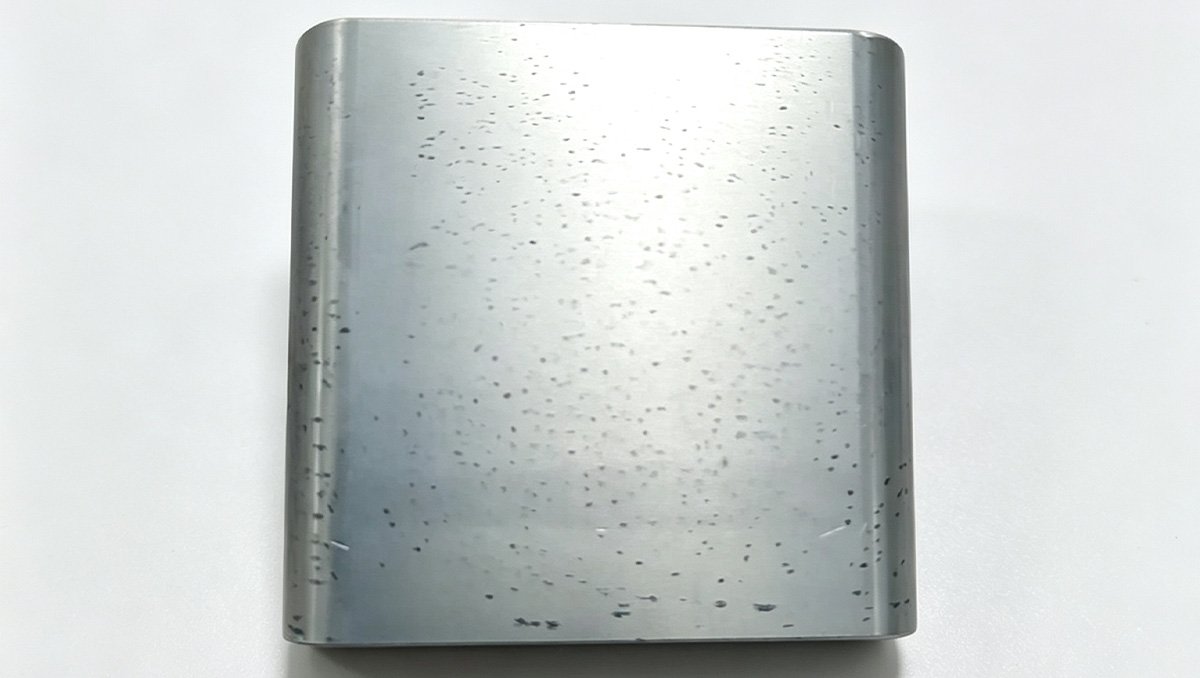
You ordered CNC machined 7075 aluminum parts with a clear anodized finish, expecting a uniform matte silver surface. Instead, you’re looking at parts dotted with small, dark specks — like black pepper scattered across the metal. Your first thought: “This is a quality failure.” In most cases, it’s not a simple manufacturing mistake. It’s a complex interaction between 7075’s unique metallurgy and the anodizing process.
What you’re seeing on the surface
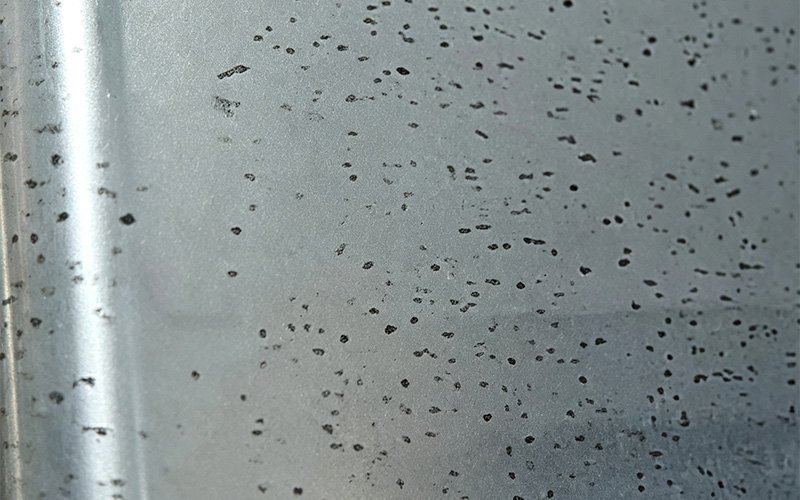
Dense black speckling on 7075 after anodizing. The spots line up with copper-rich particles in the alloy — the same reason light finishes are hard to keep even on this material.
The two most common complaints related to 7075 aluminum anodizing black defects are small dark specks scattered across the part, and larger cloudy areas that appear grey, brown, or nearly black. These flaws stand out clearly on light or clear anodized finishes. On dyed parts, the same issue often presents as uneven color uptake.
This condition is different from natural atmospheric oxidation. Bare aluminum naturally develops a thin, invisible oxide layer when exposed to air; this native layer provides inherent corrosion protection. The discoloration linked to 7075 aluminum anodizing black occurs during intentional anodizing — a controlled process built to grow a thicker protective oxide layer — and does not develop simply from parts sitting in storage. When people reference 7075 that “turns black after oxidizing”, they are nearly always describing defects formed after anodizing treatment.
The Real Cause
1. Copper and Other Alloying Elements
7075 is aluminum mixed with zinc, magnesium, and copper — and it’s the copper, at around 1.2–2%, that causes most of the trouble.
Anodizing turns the surface into a hard, see-through oxide layer, which works cleanly on pure aluminum. But 7075 is packed with tiny hard particles that make it strong but don’t anodize the same way.
Those copper-rich spots don’t oxidize cleanly, and the cleaning and etching stages leave a dark, sooty residue around them — the trade calls it “smut” — so you get dark specks and patches. The oxide it does form also comes out with a slight yellow-brown tint instead of clear, which is why light and bright colors are so hard to pull off on 7075. The more copper, the darker and blotchier it gets.
2. Off-spec Material
Cheaper or non-certified 7075 stock with inconsistent composition or inclusions is more likely to come back spotted.
3. Improper Cutting Fluid Selection & Maintenance
Using cutting fluids that are sensitive to 7-series aluminum alloys, or failing to replace the cutting fluid for a long time, can cause corrosion on the surface of aluminum parts. The corrosive components in the deteriorated cutting fluid will damage the surface integrity of the parts, leaving hidden defects that manifest as spotty black spots during anodizing.
4. Inadequate Cleaning After Machining
Failure to clean the workpiece in time after CNC machining will leave cutting fluid residues on the surface. These residues can cause localized corrosion or chemical reactions on the aluminum surface, forming tiny pits or stains that develop into visible black spots after anodizing.
5. Poor Alkali Cleaning Before Anodizing
Inadequate alkali cleaning in the anodizing plant before the oxidation process fails to completely remove surface oxides, grease, or residual contaminants. These residues hinder the uniform reaction between the aluminum surface and the electrolyte, resulting in the formation of spotty black spots in the subsequent anodizing process.
6. Incorrect Voltage in the Anodizing Tank
7-series aluminum alloys (such as 7075) and 6-series aluminum alloys require different voltage parameters during anodizing. Using the same voltage for 7075 aluminum as 6-series aluminum will lead to uneven oxide layer formation, local overheating, and eventually the appearance of spotty black spots.
Some of the darkness comes from the alloy itself, but a spotted, corroded part is often the result of one of these steps going wrong. Controlling material, machining, and anodizing together — or at least coordinating them closely — is how you keep the surface clean.
Why 6061 looks clean and 7075 doesn’t
This is the comparison most people are really asking about. Both alloys machine well and both get anodized constantly, but they finish very differently.
| 6061 | 7075 | |
|---|---|---|
| Main alloying elements | Magnesium, silicon | Zinc, magnesium, copper |
| Copper content | ~0.15–0.40% | ~1.2–2.0% |
| Anodized look | Clean and even | Darker, can be blotchy |
| Handles light and clear colors | Yes, reliably | Poorly — shows unevenness |
| Best color range | Almost anything | Black and dark shades |
| Typical use | Brackets, housings, general parts | High-stress and structural parts |
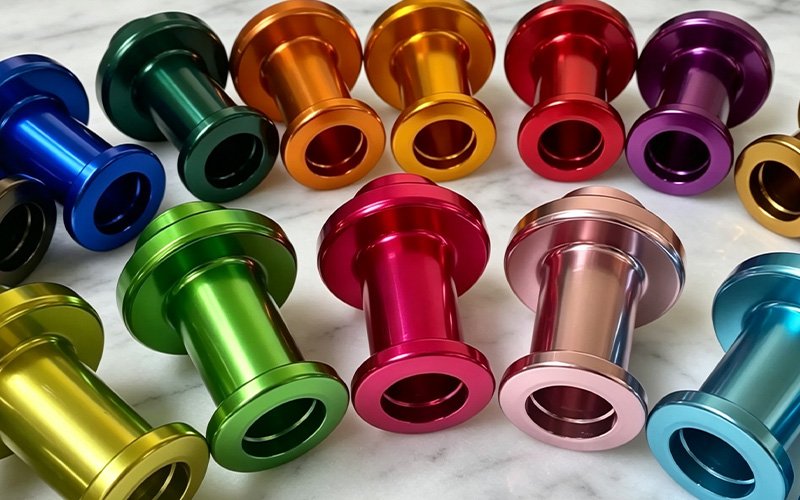
6061 has very little copper, so it forms an even, near-transparent oxide and takes a wide range of colors well, including clear and pastels. 7075 has five to ten times the copper, so it will always look darker and less uniform by comparison. This isn’t a quality difference between two shops — it’s built into the metal.
Which colors make it better or worse
The finish problem is mostly about contrast. A light or transparent finish sits right on top of the metal and hides nothing, so every dark speck shows. A dark finish covers most of it.
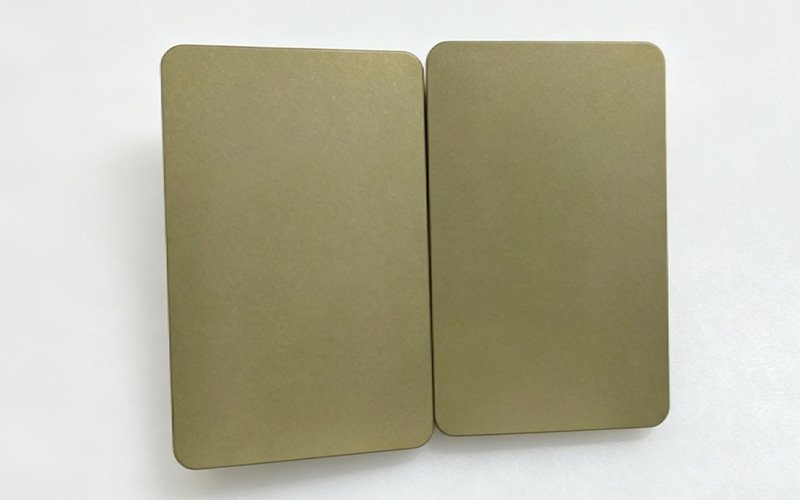
In practice, black, dark grey, and olive/military tones hide the mottling well and come out looking consistent. Mid-tones like red or deep blue are workable but can still show some unevenness. Light blue, gold, silver, and clear are the hardest to get right on 7075 and are where most disappointed parts come from. If a clean, light, even color is the goal, 6061 is usually the better material choice from the start.
Type II vs. hard anodizing (Type III) on 7075
Both regular and hard anodizing work on 7075, and each has its place.
Regular anodizing (Type II) is the decorative and general-corrosion option. It’s thinner, takes color well, and is the right pick when you care about looks and cost. On 7075 it will still show the alloy’s natural darkness, so it pairs best with darker colors.
Hard anodizing (Type III) builds a much thicker, harder layer for wear resistance and tough service conditions. It tends to come out more consistent on 7075, but the trade-off is color: hard-anodized 7075 usually finishes as a dark grey to near-black on its own, and doesn’t take bright or light colors. For structural, aerospace, and other demanding parts, that’s normally fine, since the finish is there for protection rather than appearance.
Can The Dark Finish Be Avoided or Reduced?
Some of it can be reduced with good process control, and some of it can’t, because it’s coming from the metal itself.
Is it a defect or is it normal?
For 7075, some darkness and light mottling is normal and expected, not a defect. It doesn’t affect the strength of the part or the protection the anodized layer provides. A part can look a little speckled and still be fully within spec.
It’s worth flagging as a real problem when there’s heavy, blotchy discoloration on a finish that was supposed to be light or clear, when the color is badly uneven across the part, or when there’s flaking or a chalky residue that rubs off — which usually points to a pretreatment or bath issue rather than the alloy.
Get a Free Quote for Your CNC Machining Project
Whether you need a single prototype, a small production run, we machine and anodize 7075 for industrial and structural parts as well as consumer projects like RC, cycling, and drone components. Beyond 7075, we also machine other aluminum alloys, stainless steel, steel, brass, copper, titanium, and engineering plastics, with finishing options to match. Ready to get your 7075 parts made? Contact us today.
Share this article

Written by : Alex
A quick overview of the topics covered in this article.
Latest articles
October 18, 2026
September 15, 2026
September 9, 2026