
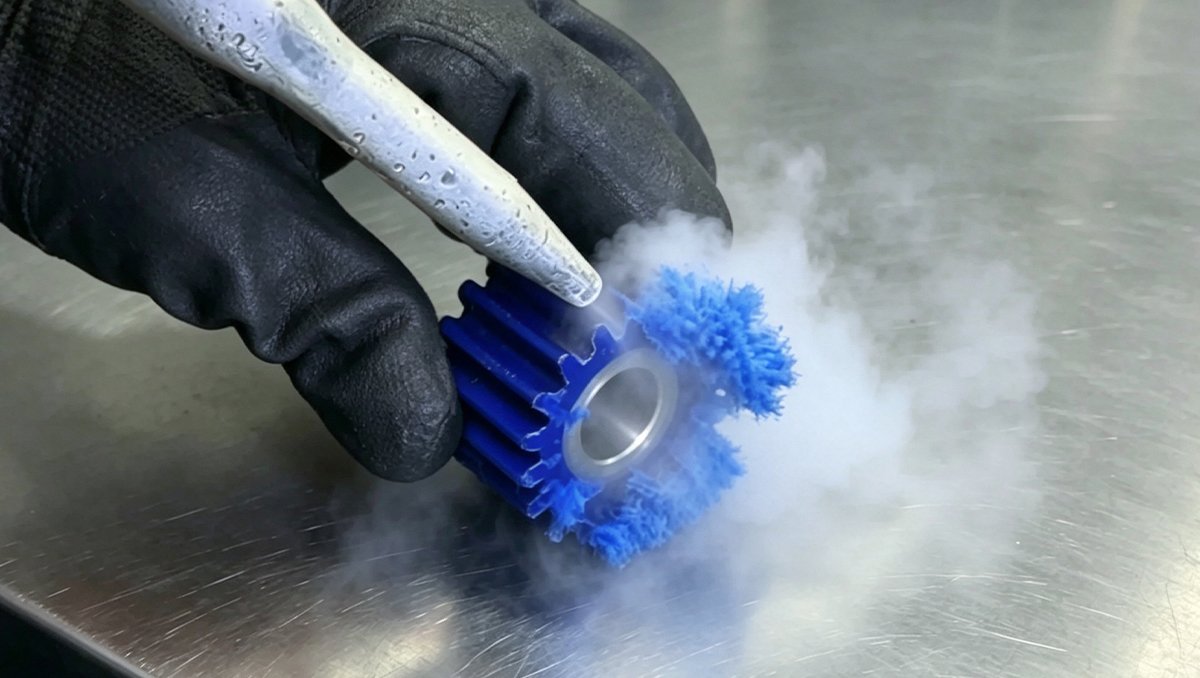
Dry Ice Deburring for CNC Machined Parts: How It Works, Pros & Cons
Burrs are the unavoidable byproduct of CNC machining. Left untreated, they interfere with assembly, compromise sealing surfaces, damage mating components, and can even cause injuries during handling. For industries like medical devices, aerospace, and electronics, a single missed burr can mean a rejected batch.
Traditional deburring methods — manual filing, tumbling, thermal or electrochemical processing — all work, but each comes with trade-offs: labor cost, surface alteration, media residue, or dimensional risk. Dry ice deburring (also called CO₂ blasting or cryogenic deburring) offers a different path: a non-abrasive, residue-free process that removes burrs without touching your part’s tolerances.
In this guide, we explain how dry ice deburring works, where it shines, where it doesn’t, and how it compares to other deburring methods — so you can decide whether it’s the right finishing step for your parts.
What Is Dry Ice Deburring?
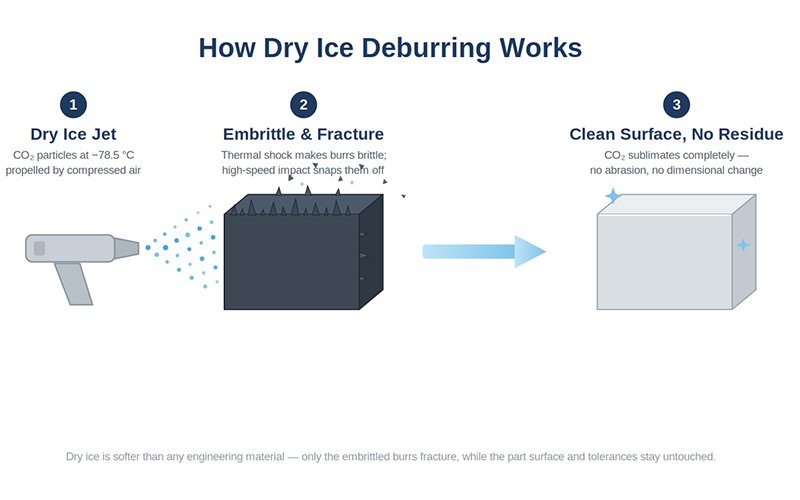
Dry ice deburring is a finishing process that uses solid carbon dioxide (CO₂) particles, propelled at high velocity by compressed air, to remove burrs from machined parts.
The process relies on two effects working together:
Thermal shock. Dry ice is extremely cold (-78.5°C / -109°F). When the particles strike a burr, the thin, protruding material cools and embrittles almost instantly — much faster than the bulk of the part. The embrittled burr becomes fragile and easy to fracture.
Kinetic impact. The high-velocity particle stream then snaps these embrittled burrs off cleanly at the root, without abrading the surrounding surface.
The key difference from sand, glass bead, or plastic media blasting: dry ice sublimates. The moment the CO₂ particles do their job, they turn directly into gas and disappear. There is no blasting media left inside blind holes, cross-drilled passages, or threads — and nothing to clean up afterward.
Advantages of Dry Ice Deburring
- No media residue: Because CO₂ sublimates completely, there are no embedded particles or trapped media in internal channels. This is critical for medical, food-contact, hydraulic, and pneumatic components, where residual blasting media is an automatic reject.
- No dimensional change: Dry ice is far softer than any engineering metal. It removes the burr — brittle, thin, weakly attached material — but does not abrade the parent surface. Tolerances, surface finish (Ra), and critical edges are preserved.
- Reaches complex geometry: The gas-entrained particle stream follows internal passages, cross-holes, and undercuts that are difficult or impossible to reach by hand or with brushes.
- Clean and dry: No coolant, solvent, or water is involved. Parts come out dry and ready for the next operation — no washing or drying step required.
- Environmentally sound: The CO₂ used is typically reclaimed as a byproduct of other industrial processes, so the process adds no new CO₂ to the atmosphere and generates no secondary waste stream (spent media, contaminated water, chemical baths).
- Gentle on soft and delicate materials: With tuned parameters, dry ice can deburr thermoplastics, elastomer-adjacent materials, and thin-walled parts that would deform in a tumbler.
Limitations
We believe in matching the process to the part, not the other way around. Dry ice deburring is not the answer to every burr:
- Large, ductile burrs: Thick, tough burrs on soft aluminum or copper may bend rather than fracture. These usually need mechanical removal first; dry ice then handles the fine secondary burrs.
- Heavy edge breaks or chamfers: If your drawing calls for a defined chamfer or radius (e.g., 0.5 × 45°), that’s a machining or brushing operation, not a deburring blast.
- Extremely cold-sensitive materials: A few polymers can micro-crack under thermal shock; we verify material compatibility before processing.
What Materials Are Suitable for Dry Ice Deburring?
Dry ice deburring is at its strongest on machined plastics, and applicable to metals on a case-by-case basis:
Plastics (ideal fit)
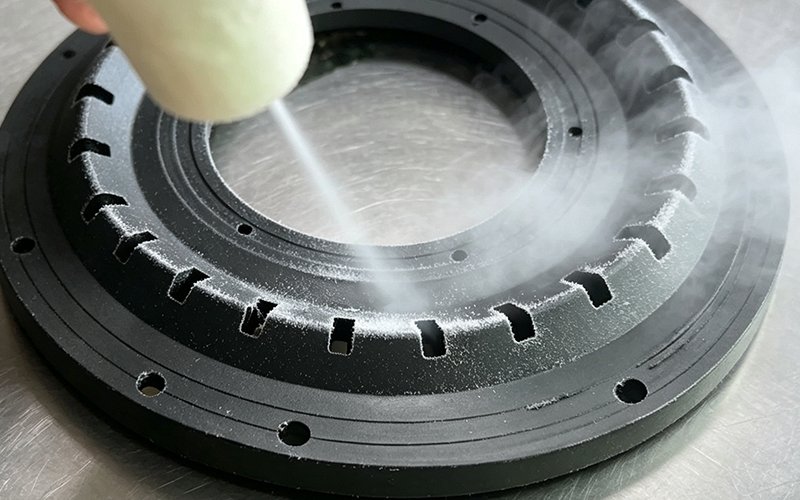
Deburring a CNC machined POM (acetal) component: the dry ice stream reaches every slot and hole, then sublimates — no media left behind in internal features.
PEEK, POM (Delrin/acetal), nylon, polycarbonate, ABS, PTFE, PPS, and most other engineering thermoplastics
Metals (application-dependent)
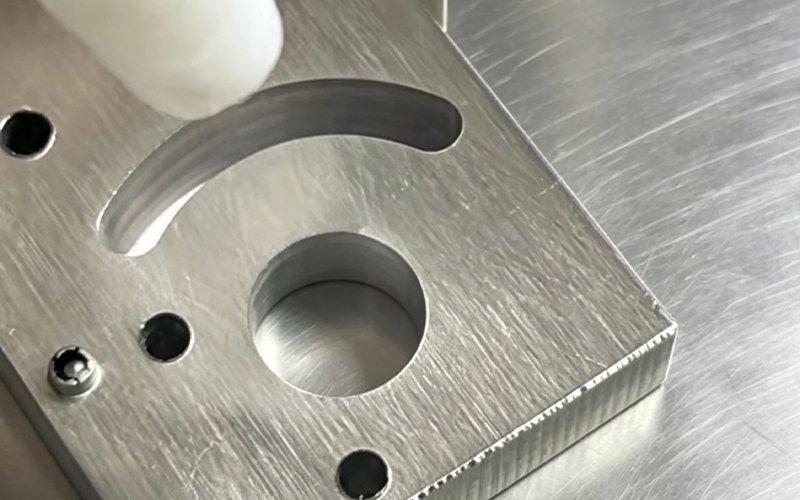
Removing fine burrs from a CNC milled aluminum plate. Dry ice works well on light metal burrs like these — larger, ductile burrs are mechanically removed first.
aluminum alloys (6061, 7075), zinc and aluminum die castings, precipitation-hardening stainless steels (e.g., 17-4PH), beryllium copper, and other non-ferrous alloys. Fine burrs on stainless and carbon steels can be removed with tuned parameters; large or ductile metal burrs require mechanical removal first. For high-strength alloys such as titanium, we confirm feasibility through sample testing before committing to production.
applications include hydraulic manifolds with cross-drilled passages, medical device components requiring residue-free finishing, aerospace fittings with strict edge-condition callouts, electronic housings with fine features, and fluid-handling components where trapped media would contaminate the system.
Custom CNC Machining: Prototypes and Low-Volume Production
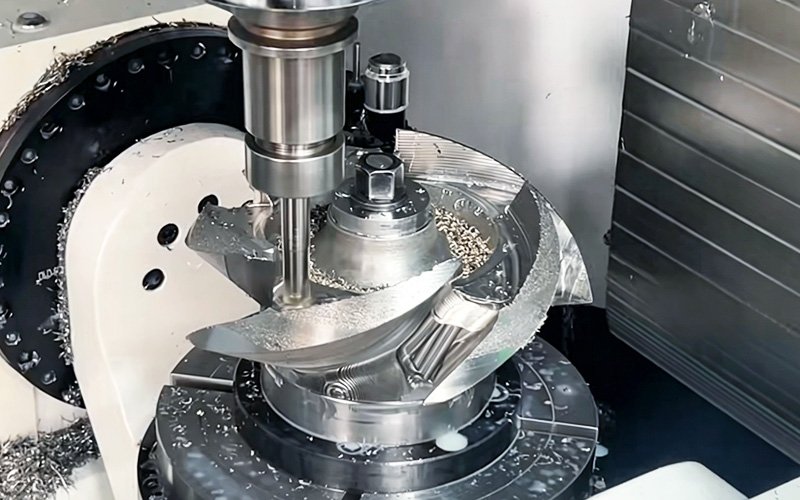
If you are researching deburring methods, you likely have parts to source as well. We machine custom components in metal and plastic, from single prototypes and pilot builds to low-volume runs of up to several thousand pieces.
Our capabilities cover CNC milling and turning in aluminum, stainless steel, brass, PEEK, POM, nylon, and more than 50 other materials, with prototype lead times as short as 3 days. Because no tooling is required, small batches remain economical.
Deburring (including dry ice), anodizing, bead blasting, and powder coating — is performed in-house, so parts arrive ready for assembly.
Send us your drawing, and we will respond with a firm price and delivery date.
Common questions
Share this article

Written by : Alex
A quick overview of the topics covered in this article.
Latest articles
October 18, 2026
September 15, 2026
September 9, 2026