
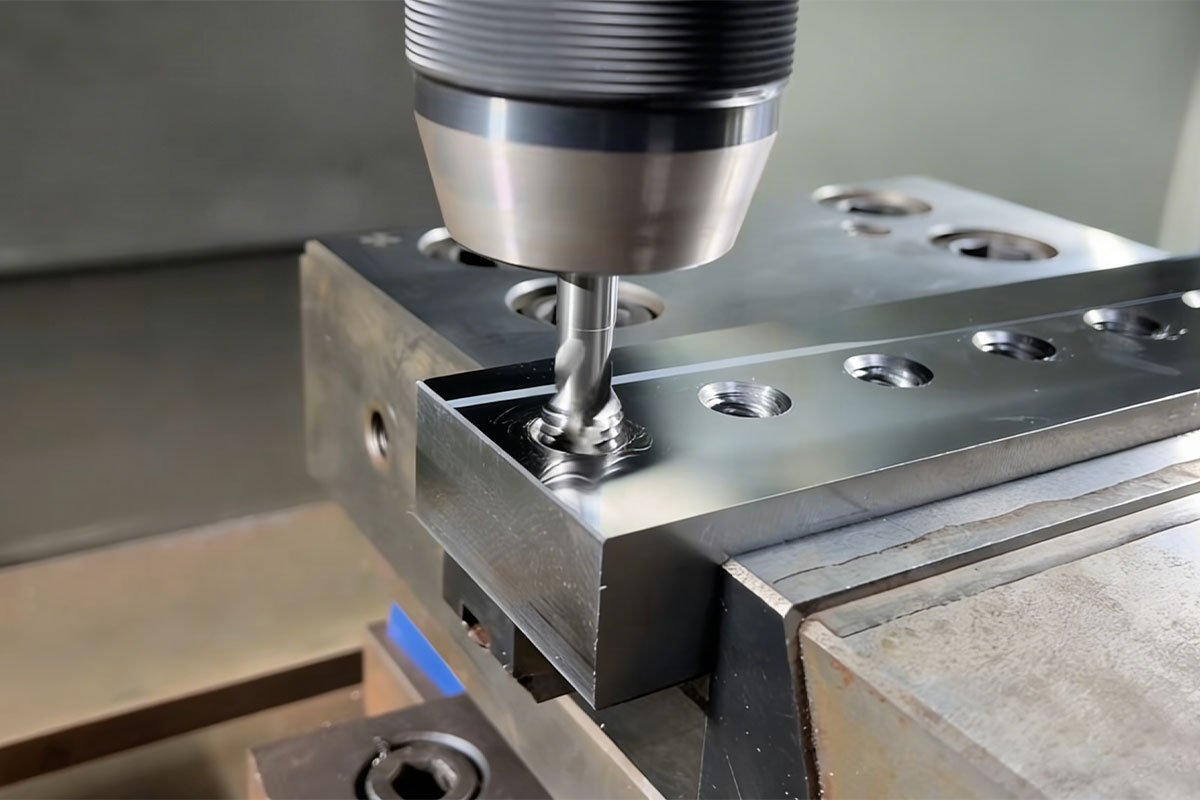
How to Prevent Stripped Threads in CNC Aluminum Parts
Aluminum parts are widely used in aerospace, automotive, electronics, and industrial equipment due to their lightweight, high thermal conductivity, and excellent corrosion resistance. However, one of the most common challenges in CNC machining of aluminum parts is the easy damage of threaded holes—stripping, deformation, cracking, or wear during machining, assembly, or long-term use. These damages not only lead to rework, material waste, and delayed delivery but also affect the structural stability and service life of the final product.
Why Are Threaded Holes in Aluminum Parts Prone to Damage?
Why Are Threaded Holes in Aluminum Parts Prone to Damage?
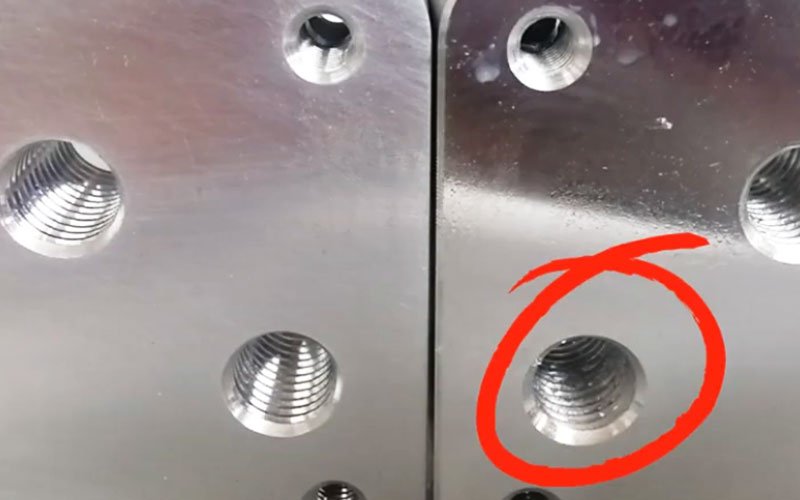
Before solving the problem, it is crucial to understand its causes. The soft texture and unique physical properties of aluminum, combined with improper machining or design, are the main reasons for threaded hole damage. Here are the 3 most common causes:
The Inherent Characteristics of Aluminum
Improper Thread Design
Unreasonable thread design is a common mistake in the early stage of part design, leading to inevitable damage during subsequent processing and use:
- Too shallow thread depth: Insufficient contact area between the thread and the bolt, resulting in excessive local stress and easy stripping.
- Inappropriate thread pitch: Too fine threads are prone to breakage, while too coarse threads have poor fit and are easy to loosen and wear.
- Lack of chamfering: No chamfer at the entrance of the threaded hole will cause stress concentration, and the thread at the entrance is easily cracked when the bolt is inserted.
- Thin wall around the threaded hole: The wall thickness around the threaded hole is too small, and the structural strength is insufficient, which will deform or crack when subjected to tightening torque.
Improper Assembly and Use
Improper assembly and use will cause damage:
- Excessive tightening torque: Exceeding the recommended torque will cause thread stripping, deformation, or even cracking of the part.
- Bolt mismatch: Using bolts with incorrect specifications (such as wrong thread size, material hardness that is too high) will wear or damage the aluminum thread.
- Contamination in the threaded hole: Dust, debris, or metal chips in the threaded hole will cause uneven force during bolt tightening, leading to thread damage.
How to Prevent Damage in the Design Stage?
The most cost-effective and efficient way to prevent damage to threaded holes in aluminum parts is to avoid risks in advance during the design stage—that is the core value of DFM (Design for Manufacturing). Through scientific design specifications, we can fundamentally reduce damage to threaded holes during machining, assembly and use, reduce rework costs, shorten production cycles, and improve product reliability. As a professional custom CNC machining service provider, we provide you with the following 4 core design suggestions based on years of experience in aluminum part processing, which are directly applicable to actual production needs.
The STI Standard & Pre-installation
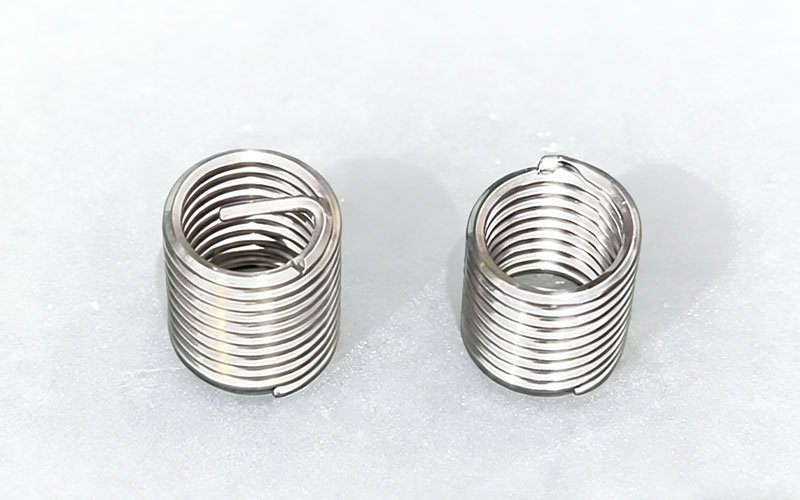
These precision-rolled stainless steel inserts provide a permanent, wear-resistant internal thread that is stronger than the original parent aluminum material.
We strongly recommend explicitly marking threaded holes as STI (Screw Thread Insert) on your part drawings. STI is the industry-standard specification designed specifically to accommodate inserts like Helicoils or Keenserts. By calling out “STI” early in the design phase, you ensure the holes are machined slightly larger to perfectly fit the insert, preventing assembly mismatches or the need for rework later.
Save Time with Our Pre-Installation Service Beyond machining, we offer a comprehensive Thread Insert Pre-installation Service. Instead of sourcing and installing inserts yourself, let us handle it. We will machine the STI holes and professionally install the specified inserts before delivery.
- Reduce Costs: Eliminate on-site assembly labor and special tooling costs.
- Guaranteed Quality: Our team ensures perfect perpendicularity and depth, avoiding the risk of damaging the threads during manual installation.
Thread Depth
- The 2x Diameter: Rule Unlike steel parts, which typically require only 1x to 1.5x the thread diameter due to their high hardness , aluminum requires a minimum engagement depth of 2x the thread diameter (2 x D).
For example: If you are designing for an M8 bolt (8mm diameter), the effective thread engagement depth should be at least 16mm.
Coarse vs. Fine Threads
When designing aluminum parts with threaded holes, we recommend using Coarse Threads (coarse-pitch threads) instead of Fine Threads (fine-pitch threads). The core reason is that coarse-pitch threads have deeper thread profiles and larger cross-sectional areas, which can bear greater torque and load, and are not easy to strip or deform.
Fine threads are more suitable for precision adjustment, light load or sealed scenarios, but their shallow thread profile and small contact area make them easy to wear and strip when matched with soft aluminum materials. Coarse threads are more compatible with aluminum parts, and their processing is simpler and more efficient, which can also reduce the risk of burrs and thread damage during CNC machining.
Anodizing
Anodizing is a common surface treatment method for aluminum parts, and hard anodizing (a type of anodizing) can effectively help prevent threaded hole damage. Hard anodizing can form a dense, hard oxide film (hardness up to HV300-HV500) on the surface of aluminum parts, including the thread surface.
How Does Our CNC Machining Factory Ensure Thread Quality?
How Does Our CNC Machining Factory Ensure Thread Quality?
As a professional custom CNC aluminum part machining service provider, thread quality is one of our core competencies. We deeply understand that high-quality threads are the foundation of stable product structure and long service life. Therefore, we have established a complete set of standardized processes from tool selection, quality inspection to service support, to fully ensure that every threaded hole meets customer requirements, allowing you to avoid worries about thread damage, insufficient precision and other issues, saving time, effort and cost.
Proper Tooling
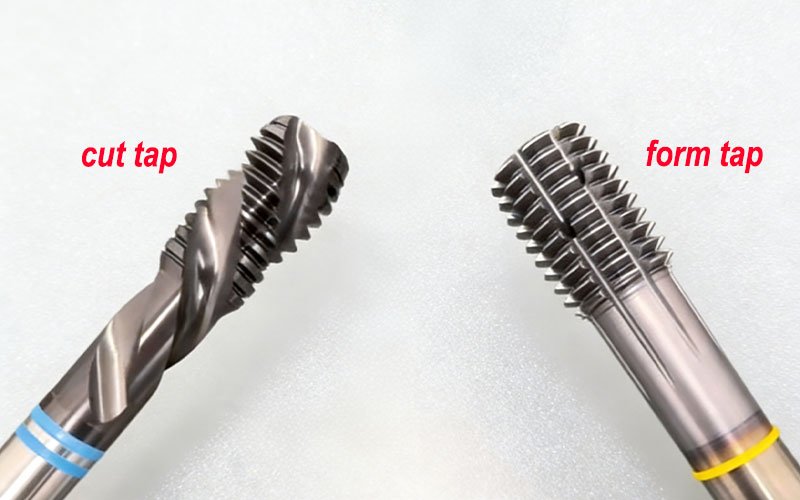
On the left is a traditional Cut Tap, which removes material to form threads. On the right is our preferred Form Tap (Extrusion Tap). Unlike cutting, form tapping uses cold extrusion to compress the aluminum, creating a harder, smoother, and significantly stronger internal thread.
We use high-quality Form taps (extrusion taps) instead of Cut taps (cutting taps) for aluminum part thread machining. The core advantage of form taps is that they do not cut the aluminum material, but form threads through cold extrusion. This cold working process can cold-work harden the surface of the aluminum thread, significantly improving the surface hardness, wear resistance and structural strength of the thread.
Compared with cut taps, form taps can avoid thread tearing, burrs and other defects caused by cutting, making the thread profile more complete and smooth; at the same time, the cold-hardened thread surface is not easy to strip or wear, which can effectively reduce the risk of thread damage during assembly and use. All our form taps are aluminum-specific, with TiN coating, which further reduces friction and improves tool service life and machining efficiency.
Quality Control
To ensure that every threaded hole meets the standard, we implement 100% full inspection of threads using Go/No-Go Gauges (thread plug gauges) after machining. Go/No-Go Gauges are industry-standard thread detection tools, which can quickly and accurately detect whether the thread pitch, diameter, and fit accuracy meet the design requirements.
Our professional quality inspection team operates in strict accordance with the inspection standards: the “Go” gauge can smoothly pass through the threaded hole, indicating that the thread size is within the allowable upper limit; the “No-Go” gauge cannot pass through, indicating that the thread size does not exceed the allowable lower limit. Only threaded holes that pass both inspections are qualified, which completely eliminates the risk of unqualified threads leaving the factory.
One-stop Service
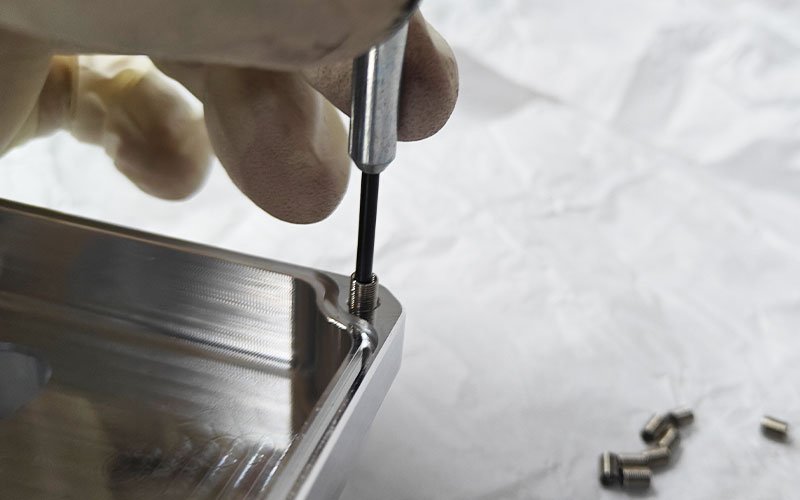
Our technician pre-installing high-strength M3 stainless steel wire thread inserts (Helicoils) into a custom-machined aluminum housing to prevent thread stripping and wear.
We provide a one-stop thread insert procurement and installation service, covering all types of thread inserts required for aluminum parts, including Helicoil (wire thread inserts), Keensert (key-locking inserts). Pre-installation before delivery.
This means that the parts you receive are finished products that can be directly assembled—no need to purchase thread inserts separately, no need to arrange on-site installation, which saves your procurement cost, labor cost and installation time. At the same time, our professional installation team ensures the installation accuracy of the inserts, avoiding thread damage caused by improper installation, and ensuring the overall performance of the parts.
Tired of installing inserts manually? Send us your drawings with ‘STI’ specified, and we’ll deliver parts with inserts pre-installed and ready for assembly. Get a Quote Today!
How to Repair Damaged Threads?
After threads are damaged, there is no need to discard the parts directly. Their performance can be restored or even enhanced through scientific repair methods.
Re-tapping
Re-tapping: If the damage is slight, re-tapping is a simple and cost-effective repair method. It is suitable for minor damage such as small burrs, slight thread wear, or partial thread adhesion caused by improper machining or assembly.
Thread Inserts
Helicoil (Wire Thread Inserts)
Helicoil (Wire Thread Inserts) is the most commonly used thread insert in industrial production, featuring compact structure, space-saving, and excellent compatibility. It is made of high-strength stainless steel wire rolled into a spiral shape, with a thread profile that matches both the internal thread of the base hole (aluminum part) and the external thread of the bolt.
It does not significantly increase the size of the threaded hole, making it ideal for parts with limited space (such as thin-walled aluminum parts); the stainless steel material has good wear resistance and corrosion resistance, which can effectively solve the problem of poor wear resistance of aluminum threads.
Keensert (Key-locking Inserts)
Time-sert
Conclusion
Conclusion
Although the threads of aluminum parts are fragile, they can be completely solved through correct design (adding thread inserts) and professional machining processes.
A professional team with more than 10 years of experience in CNC machining of aluminum parts, support prototype production and small-batch production with fast delivery. Contact us now to get a free quote and design consultation.
Share this article

Written by : Alex
A quick overview of the topics covered in this article.
Latest articles
February 21, 2026
February 21, 2026
February 21, 2026