
Our Machining Projects
Why Choose Us?
-Custom parts from your drawings, no MOQ.
-End-to-end service: sourcing, machining, finishing & QC.
-Streamlined process = on-time delivery, every time.
Custom GF30 Nylon Machining: Keeping a Thin Mounting Plate Flat
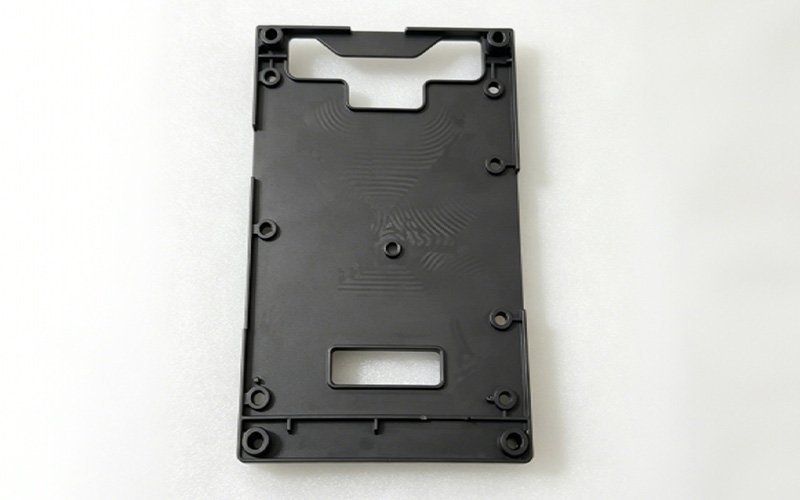
We machine mounting plates from solid PA66 + 30% glass fiber material according to customer drawings. The plate has uniform thin walls, screw bosses around its perimeter, a shaped cutout at the top, a rectangular window at the bottom, and one central hole. The difficulty lies in the proportions: it’s a large, thin plate made of a material with internal stress, so the whole process of custom GF30 nylon machining is focused on keeping the plate flat.
GF30 nylon is plain nylon mixed with 30% glass fiber. The glass fiber increases the material’s stiffness and dimensional stability. Like all nylon materials, it absorbs moisture from the air and expands slightly after absorbing water.
How We Kept the Plate Flat
The whole machining process was carried out in stages. We did rough machining first, leaving machining allowance on all parts, then took the workpiece off the machine and let it sit for a while. Rough machining releases the internal stress of the material, which causes the plate to warp. It’s better to let this warping happen before finish machining rather than after.
For finish machining, we couldn’t use the standard clamping method. If we only clamp a thin plate at a few points, it will undergo elastic deformation, and bounce back in other places when released. So we made a conformal vacuum fixture — the upper surface of the fixture perfectly matches the underside of the workpiece, pressing the whole surface of the workpiece down. In addition, we fixed the thin perimeter and cutout areas with hot glue, so the edges wouldn’t lift up or chatter when the cutter was cutting the outline.
Coolant was used continuously throughout the machining process. Nylon retains heat easily, and once the plate warms up, it will deform. It’s impossible to machine a flat part from a warm blank.
After the final machining pass, we put the parts into water to soak. Machined nylon will absorb moisture in actual use anyway and change size slightly, so we soak the finished parts first to bring them to a stable state. This way, we don’t ship them dry and avoid the size change happening at the customer’s end.
Project Details
Part type: Custom GF30 Nylon Mounting Plate
Material: PA66 + 30% Glass Fiber (GF30 Nylon)
Machining Process: CNC Milling
Surface Finish: As-Machined
What PA66 GF30 Is Good For
PA66 with 30% glass fiber is a common type of filled nylon. It’s stiff, dimensionally stable, and reasonably priced, so it’s widely used in many industries. Plain PA66 lacks enough stiffness and creep resistance, and adding glass fiber makes up for these shortcomings. That’s why it’s used to make parts that need to bear loads or keep their shape, such as mounting plates and backplates in control equipment, structural panels in battery and power modules, brackets, gears, pump housings, and fixtures that work in slightly hot environments.
It has good insulation performance, can work continuously at around 120°C, and isn’t easily damaged by oils and fuels. Its disadvantages are also obvious: it absorbs moisture and changes shape a little after absorbing water. It also can’t stand strong acids or long-term contact with hot water. If parts need to work underwater for a long time, PEEK is a better choice instead of nylon.
Free Quote & Design Review
We provide custom CNC machining services for low-volume production and Rapid Prototyping for design verification. Click Here to Upload Your CAD Files
Our Manufacturing Capabilities
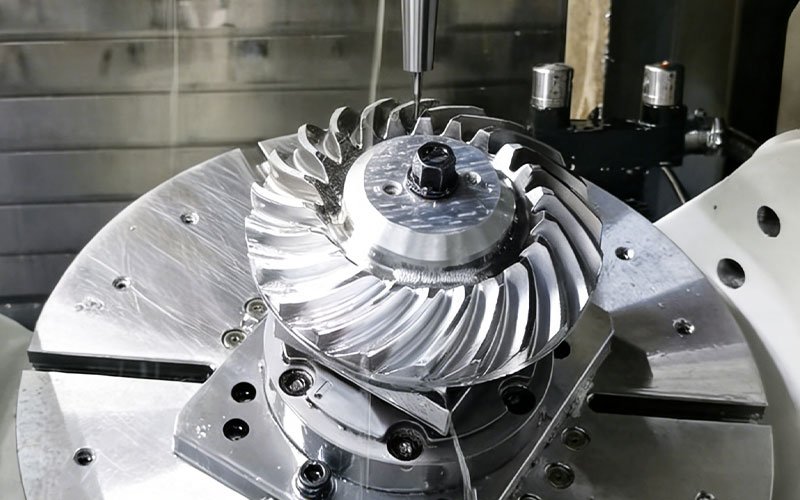
Capabilities include 3-axis and 5-axis CNC milling, as well as CNC turning. Materials include aluminum alloys, stainless steel, titanium, and engineering plastics, among others.
Available secondary operations include anodizing, powder coating, bead blasting, and laser engraving.
Capacity supports everything from single-unit rapid prototyping to low-volume production runs of 1 to 1,000+ units.
Factory Quality Assurance
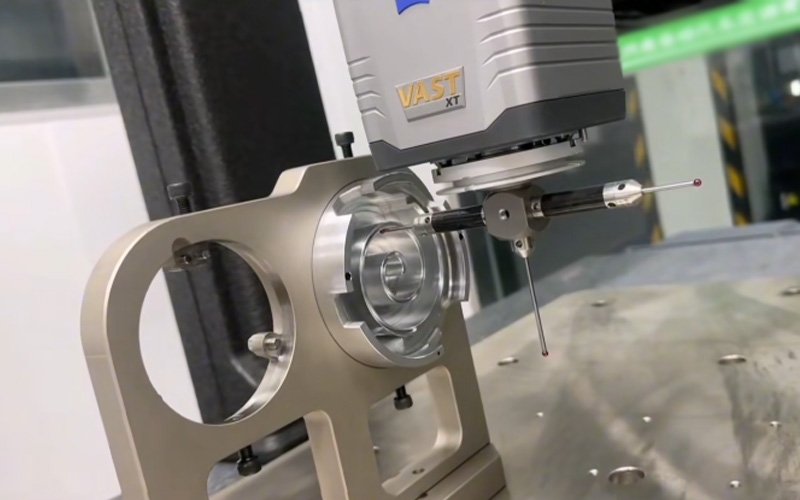
A standardized Quality Management System (QMS) is applied to all manufacturing orders, regardless of part complexity or production volume. The following inspection stages are mandatory for every CNC machining project:
Order Fulfillment Process
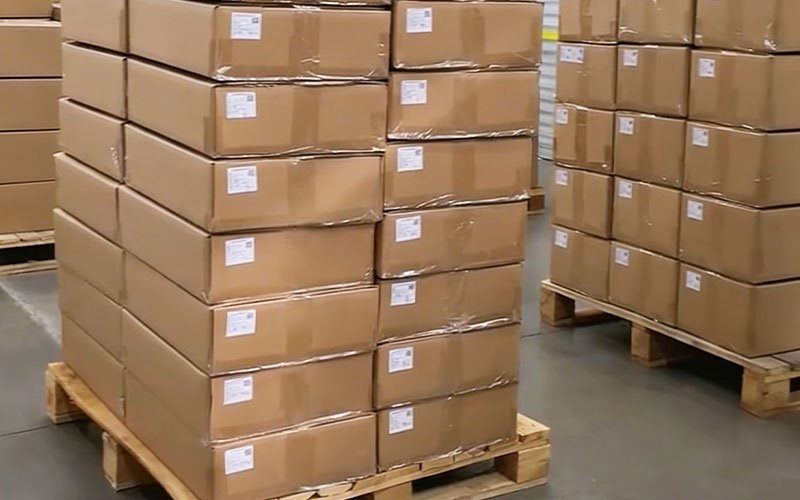
From CAD to part.
FAQs About CNC Machining Services
Latest articles
October 18, 2026
September 15, 2026
September 4, 2026