
Available Copper Grades
Our manufacturing capabilities include 3-axis and 5-axis CNC milling and turning for various copper alloys, including C101 and C145.
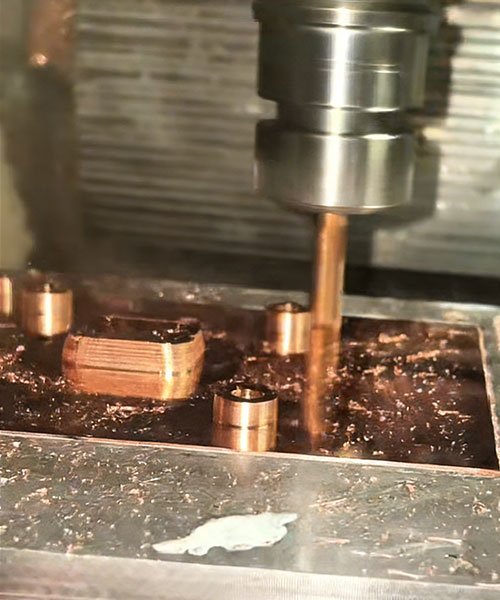
Copper C145 (Tellurium Copper)
By adding 0.5% Tellurium, C145 transforms copper’s machinability. It produces short, clean chips rather than long stringy ones, allowing for faster machining speeds and tighter tolerances while retaining ~93% IACS conductivity.
Key Specs:
Purity: ~99.5%
Machinability Rating: 85% (Excellent)
Conductivity: High (Very close to pure copper)
Best For: High-volume screw machine parts, nozzles, complex electrical connectors, plasma torch tips.
Our Tip: “If your part has complex threads or requires deep drilling, C145 will significantly lower your machining costs.
Copper C110 (Electrolytic Tough Pitch – ETP)
C110 is the most widely used copper grade. It offers exceptional electrical conductivity (101% IACS) and thermal properties. However, it is soft and “gummy,” requiring specialized CNC strategies to prevent burrs.
Key Specs:
Purity: 99.90%
Machinability Rating: 20% (Challenging)
Conductivity: Excellent
Best For: Busbars, electrical contacts, gaskets, rivets.
Our Tip: “Great for simple geometries. For complex parts with tiny holes, consider C145 to reduce cost.
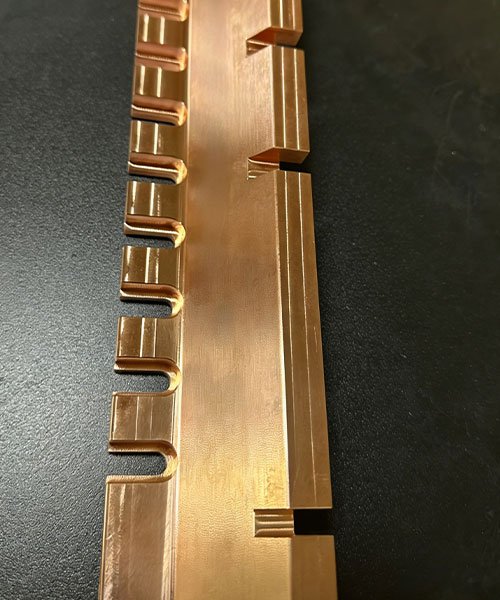
Material Properties
| Property | C145 Tellurium Copper | C110 ETP Copper | difference |
| Machinability | 85–90% (Ref: Free Cutting Brass = 100%) | ~20% | C145: Produces short, brittle chips; extends tool life; ideal for complex or high-volume CNC parts. C110: “Gummy” texture; prone to sticking/galling; produces long stringy chips; lower machining efficiency. |
| Electrical Conductivity | 85–93% IACS | 100–101% IACS | C110: Best for applications requiring minimal electrical loss. C145: Sufficient for the majority of general conductive components. |
| Thermal Conductivity | Good (Approx. 355 W/m·K) | 394 W/m·K | C110: Superior heat dissipation; preferred for high-power thermal management components. |
| Tensile Strength | 350–380 MPa | 220–385 MPa (Varies by temper) | C145: Offers more consistent mechanical strength and better wear resistance. C110: Strength depends heavily on hardness state (soft vs. hard). |
| Elongation | 15–50% | >35% (Annealed) | C110: Higher ductility; superior for cold forming, bending, or deep drawing processes. |
| Hydrogen Embrittlement | Low (Phosphorus deoxidized) | Medium | C145: Stable during heating or brazing. C110: Requires caution in high-temperature reducing atmospheres to avoid embrittlement. |
| Weldability | Good for brazing/soldering; Fair for arc welding | Excellent | C110: Suitable for all welding types and general electrical connections. |
In short: Choose C110 for maximum conductivity and simple shapes. Choose C145 for complex CNC parts to reduce machining costs.
FAQs About CNC Machining Services